The Three Warrior Plants: Yarrow, Elder, and Turkey Tail
May 12
/
MWIH Team
From Matthew Wood’s teaching on the shamanic garden
Matthew Wood Institute of Herbalism | From the class: Planting a Shamanic Garden (Real Spirit Highway, April 15, 2026)
In Homer’s Iliad, Achilles is said to have carried a single herb into battle: a powder the centaur Chiron taught him to use on the wounds of his men. The herb was yarrow. Three thousand years later it still grows in the meadow, and the same name still attaches to it: Achillea millefolium, Achilles’ plant. The tradition is that old and that continuous.
Yarrow is one of three herbs that carry warrior medicine: remedies associated with guarding the surface of the body, defending against attack, and holding form when the system is under siege. The other two herbs are elder and turkey tail. Each one carries the signature (or form) of the shield.
The ideas that follow are inspired by Matthew’s vision of a shamanic garden and the teachings and stories surrounding it.
The short version: In Western herbalism, three plants carry the signature of the shield: yarrow, elder, and turkey tail. Each guards a different layer of the body. Yarrow (Achillea millefolium) protects the blood and capillaries, traditionally used for wounds, bleeding, and the first sign of fever. Elder (Sambucus nigra) protects the skin and mucosa with profound antiviral and diaphoretic action and is traditionally used for colds, flu, and fevers. Turkey tail (Trametes versicolor) protects the cells themselves through immune surveillance, used as an ongoing immune tonic and, in Japanese and Chinese integrative medicine, it’s used alongside cancer care. Together these three herbs form the foundation of immune defense.
What ‘Warrior Medicine’ Means: The Shield Signature in Herbalism
Plants are read not just by their chemistry but by their form, their traditional associations, and the “animal medicine” associated with them. The warrior plants are those carrying the signature of the shield: they resemble a physical shield, indicating their protective uses. When an herb looks like a part of the body or hints at a function — in this case a shield — it’s called a “signature.” This is the pattern-reading tradition the Doctrine of Signatures describes, and it is as old as Western herbalism itself. These shield herbs guard the surface of the body, protect against viral and microbial attack, and hold the integrity of the boundary between self and outside world.
“The shield remedies generally are for viruses, common cold, influenza. They’re acute remedies as well as they have many other properties. They guard the surface.”
Matthew teaches these herbs as a group because they share this signature, even though they come from different plant families and work through different physiological mechanisms. The framework is about pattern, not taxonomy.
Yarrow: Master of the Blood — Traditional Uses for Wounds, Fever, and Bleeding
Yarrow (Achillea millefolium) is the first of the warrior plants, and in many ways the most complete. Matthew calls it the “Master of the blood.” When you look at the plant, the flat-topped flower cluster resembles the signature of the shield. The narrow, lacy, feathery leaves indicate the capillaries.
What yarrow does, traditionally, is control blood. It stops profuse bleeding when applied to deep cuts. It moves blood to the surface to release heat in a fever, then brings it back to the center. It controls the capillaries, which is why it works across such a wide range of situations that involve circulation.
The name itself carries history: yarrow’s Latin name, Achillea, is from Achilles, the Greek warrior. In Homer’s Iliad, Achilles is said to have used powdered yarrow root on the wounds of his men, a technique taught to him by the centaur Chiron. The tradition is this old and this continuous.
“Achilles supposed to have said, ‘If only I had my herb, I would survive.’”
For household use, yarrow is traditionally taken as tea at the first sign of fever, applied as powder or fresh poultice for wounds. It grows in sunny, dry places and can withstand compact soil as long as it’s well-drained.
Elder: The Queen of the Underworld — Antiviral, Diaphoretic, Fever Herb
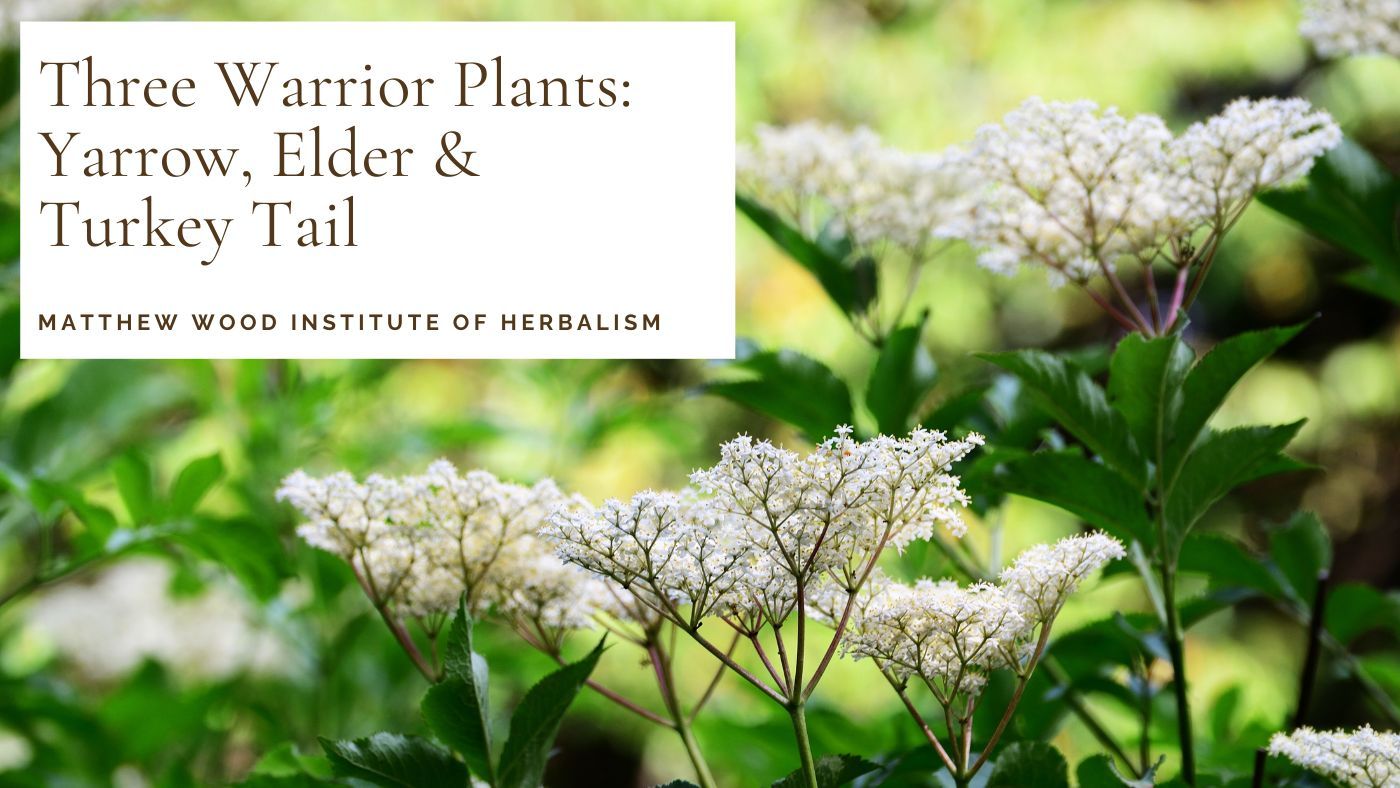
Elder (Sambucus nigra) is the second warrior plant, and the one carrying the deepest mythological weight in European tradition. Its flat-topped white flower clusters carry the same shield signature as yarrow.
In European folk tradition, elder was understood as the representative of the queen of the underworld: the queen of the fairies, of nature herself. Peasants would put out milk as an offering beneath the elder tree, then bring their harvested herbs to the church on the Ascension of Mother Mary on August 15th to be blessed. Both the queen of heaven and the queen of earth, both traditions honored together. Some European gardeners plant elder in the center of an herb garden, or in all four corners, to mark the sacred ground.
“This was very central. Unlike the American Indians who’d give an offering for each plant, they gave an offering to the one major, the mother plant.”
Clinically, elder is a profound antiviral and diaphoretic: the flower opens the skin and breaks fevers, and the berry is a traditional respiratory aid and flu remedy. Depending on preparation, it acts on the kidneys, the colon, the skin, or the lungs. The flowers dry on screens in late June; the berries ripen later in the summer. The red-berried elder (Sambucus racemosa) is somewhat toxic and requires careful use; the black-berried species are the traditional medicine.
Elder trees can live for centuries. Matthew notes that he has seen one on a hill in Lake County, California, that was hollowed out in the middle, just rings of old bark around a central void — still alive, still bearing fruit.
Free download: Summer Herbal Kit
Our companion guide walks through the plants of summer first aid — what to have on hand, where to find them, and how the tradition uses each one. Yarrow and elder are in there, along with the rest of the household summer kit. No cost, just the next step in learning to read the plants around you. Download the Summer Herbal Kit free.
Turkey Tail: The Shield of the Immune System — Traditional Immune and Cancer-Supportive Uses
The third warrior plant is unusual — it’s a mushroom, not a plant in the strict sense, and Matthew only began including it in his warrior medicine teaching more recently. Turkey tail (Trametes versicolor) grows on decaying wood, its overlapping colored bands echoing the fanned tail feathers of a wild turkey.
What makes it a warrior medicine is how it works in the body. Turkey tail increases the production of natural killer cells in the bone marrow. These cells patrol the body, checking the DNA of every cell they pass. When they find cells that are replicating incorrectly — cancer, virus-infected, or aberrant — they alert the immune system to destroy them.
“Anything really that’s antiviral is like a shield.”
Matthew learned an additional layer from his friend Chris McPadden, an Ojibwe herbalist: in Ojibwe traditional teaching, the turkey carries “warrior medicine.” The turkey puts up its wing so fast that it can function as a shield, capable of deflecting arrows and even buckshot. Turkey tail carries the name and the signature of the animal, and the animal carries the warrior medicine.
Turkey tail is among the most important anti-cancer remedies used in Japanese and Chinese integrative cancer medicine. It’s traditionally prepared as a double extraction (using both alcohol and water), because different constituents are water-soluble versus alcohol-soluble. Our Intermediate/Advanced Herbal Medicine Making course covers the method in working detail.
How the Three Work Together
The three warrior plants address different layers of the same pattern. Yarrow guards the blood, the capillaries, the surface response of the body to injury and illness. Elder works on the skin and mucosa, the body’s larger boundaries, with particular power against viruses. Turkey tail works at the cellular level, on the immune surveillance that guards every cell in the body.
These three are the foundation of a defensive protocol: yarrow and elder at the first sign of fever or illness, and turkey tail as an ongoing support for immune function.
-
Plant
-
Guards
-
Traditional Use
-
Yarrow (Achillea millefolium)
-
Blood and capillaries
-
First sign of fever, wounds, profuse bleeding. Tea, fresh poultice, dried powder.
-
Elder (Sambucus nigra)
-
Skin and mucosa — outer boundariesItem
-
Colds, flu, fevers, expectorant support. Dried flowers (tea), cooked black berries (syrup).
-
Turkey tail (Trametes versicolor)
-
Cells — immune surveillance
-
Ongoing immune tonic; alongside cancer care in Japanese and Chinese integrative medicine. Double extraction (alcohol + water).
The Deeper Pattern
The warrior plants aren’t just a list of three herbs — it’s a way of reading plants, from looking at form, traditional associations, animal medicine, and shield signature.
Once you can read it, you can see it in other plants too. The pattern becomes legible. That’s what it means to study in herbalism.
Frequently Asked Questions
What is turkey tail mushroom traditionally used for?
Turkey tail (Trametes versicolor) is traditionally associated with immune support, particularly with increasing the activity of natural killer cells in the bone marrow, the cells that patrol the body checking for cells replicating incorrectly. It’s among the most-studied mushrooms in Japanese and Chinese integrative cancer medicine, where extracts are used alongside conventional treatment. Outside those clinical contexts, the tradition uses it as an ongoing immune tonic. It’s typically prepared as a double extraction (alcohol and water extractions) because different active compounds dissolve in different solvents.
Is elderberry safe to eat raw?
Raw elderberries contain compounds that can cause nausea and digestive upset; they are traditionally always cooked before use, which neutralizes those compounds. The dried flowers and properly cooked black berries (Sambucus nigra or S. canadensis) are the traditional medicinal parts. Note: red-berried elder (Sambucus racemosa) is a different species and should not be used due to its toxicity. When sourcing dried berries or finished products, the black species is what you want.
How do you tell yarrow apart from poison hemlock?
Yarrow and poison hemlock (Conium maculatum) both have flat-topped white flower clusters, which can confuse new foragers — and the consequences of getting it wrong are serious. The reliable distinctions are in the leaves and the stems. Yarrow has fine, feathery, almost lacy leaves. Hemlock has broad, fern-like leaves more like a carrot, and its stems carry distinctive purple blotches. Hemlock is also tall and tree-like, often six feet or more; yarrow stays low and meadow-like, usually under three feet. If there is any doubt at all, don’t harvest — work with a teacher or an experienced forager until the identification is confident.
How do you tell elder apart from poison hemlock?
Elder (Sambucus nigra or S. canadensis) and poison hemlock (Conium maculatum) can sometimes grow in the same places and both carry clusters of small white flowers, but they are very different plants once you look closely. Elder is a woody shrub or small tree with brown bark and branching stems. Its leaves grow in opposite pairs along the stem and are made up of several serrated leaflets. Poison hemlock is an herbaceous plant, not woody, with hollow green stems marked by distinctive purple blotches. Its leaves are delicate, fern-like, and finely divided, more like parsley or carrot tops. Elder flowers form broad, creamy clusters on branching woody stems; hemlock flowers appear in umbrella-shaped sprays rising from smooth, spotted stalks. If there is any uncertainty at all, do not harvest — poison hemlock is highly toxic, and careful identification with an experienced teacher or forager is essential.
What does warrior medicine mean?
Plants are read by their form, by traditional association, and by “animal medicine” — not only by their chemistry or their botanical relationship. Warrior medicine is the category of plants that carry the signature of the shield, meaning that they actually look like a shield: being flat and broad in nature, with some plants displaying flat-topped flower clusters. They guard the surface of the body and are associated with protection and defense. If this way of reading plants is new to you, our free Doctrine of Signatures starter kit is a good place to begin. Yarrow, elder, and turkey tail are the three plants Matthew teaches most directly in this category, though the pattern shows up elsewhere once you know how to read it.
Can these herbs be used alongside conventional medicine?
The Western and Asian herbal traditions often use these plants alongside conventional medicine, particularly turkey tail in integrative cancer care. That said, every herb has the potential to interact with prescription medications, and the right call depends on the person, the medication, and the circumstance. Anyone in active treatment — for cancer, autoimmune disease, or any serious condition — should consult a qualified clinical herbalist or integrative practitioner before starting or stopping any herb.
How do you prepare turkey tail as a double extraction?
Double extraction means preparing the mushroom in both alcohol and water, because some active compounds dissolve in one and not the other. Dried turkey tail is simmered in water for a decoction, freezing the water to save it to add to the alcohol extraction; the same mushrooms are then separately prepared in a high-proof alcohol for several weeks. The two liquids are then combined to a target alcohol percentage. Proportions and timing vary across teachers and traditions — our Intermediate/Advanced Herbal Medicine Making course covers the method in working detail.
Ready to actually start? Try the Starting Path.
Reading about herbs is one thing. Using them is another. Starting Path is the place to begin — seasonal herbs, everyday remedies, and the context to make sense of modern wellness, one step at a time. No background needed. $20/month, cancel anytime.
Go deeper: Real Spirit Highway (free enrollment)
This blog was drawn from one class of MWIH’s Real Spirit Highway — an ongoing free series of mystical, intuitive, consciousness-oriented conversations between Matthew and guest teachers. Animal spirits, plant patterns, shamanic traditions, the deeper teachings the tradition uses to read the world. Other-worldly stories and practical teaching, together — the kind of work you don’t usually find written down.
If the warrior plants drew you in, this is where it continues. Enroll free for access to previous recordings (including Planting a Shamanic Garden, the class this article came from) and an invitation to every future live class.
**Permissions**
You’re welcome to share this blog post on social media and link back to it—please do! All images, photos, and written content are the creative property of the author and used with permission. If you’d like to reproduce or distribute any part of this content beyond social sharing, written permission is required.
**Disclaimer**
The information provided in this digital content is for educational purposes only and is not intended as medical advice, diagnosis, or treatment. It should not be used as a substitute for consultation with a qualified healthcare professional. Always consult a licensed healthcare provider before making any changes to your health regimen, especially if you are pregnant, nursing, taking medications, or have a diagnosed medical condition.
Matthew Wood, the Matthew Wood Institute of Herbalism, Earth to Stars Productions, and their employees, guests, affiliates, and collaborators assume no liability for the use or misuse of any information presented. The application of any material is solely the responsibility of the reader or participant.
Any descriptions of herbal or natural products, remedies, or techniques are for informational purposes only. These statements have not been evaluated by the Food and Drug Administration (FDA). This content is not intended to diagnose, treat, cure, or prevent any disease.
Participation in educational programs or use of this material does not confer certification, licensure, or professional qualification in herbal medicine or any healthcare field. Results or experiences described may vary and are not guaranteed.
This disclaimer shall be governed by and construed in accordance with the laws of Minnesota, USA, without regard to conflict of law principles.
Featured links
Connect with us
Copyright © 2023-2026 Matthew Wood Institute of Herbalism